Raffle Items
Browse the Items
-
Item One
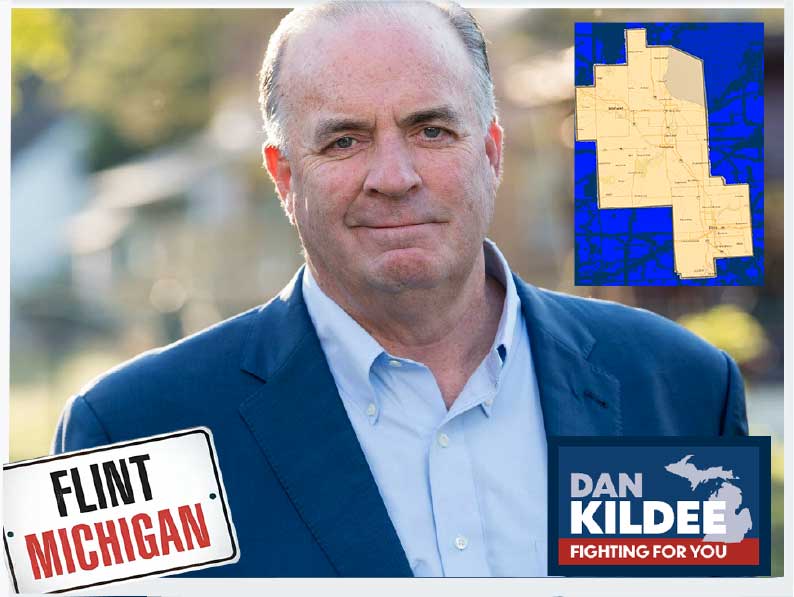
Dinner with Dan Kildee to Reflect on the Nov 3rd election.
If you are the lucky winner of this raffle prize, we will coordinate with you on the time and date for this dinner.
Former Michigan 8th District Representative Dan Kildee has generously agreed to donate a dinner with him on a Wednesday of your choosing in November at Jakes Old City Hall, 100 S. Hamilton in Saginaw.
You and another guest of your choosing will be Dan Kildee’s guests for dinner. He will discuss the Michigan midterm election and reflect on his long career of public service, since he was elected at age 18 to the Flint School Board in 1977.
Dan served as a Member of the U.S. Congress from 2013-2025, representing Michigan’s 8th, and before that he was previously Michigan’s 5th Congressional district. He served on the Ways and Means Committee and the Budget Committee. He also co-chaired the bipartisan Congressional PFAS Task Force, charged with the urgent clean-up of toxic PFAS “forever chemicals.” Congressmen Kildee secured federal funding of $170 million to help Flint replace lead pipes during the water crisis.
After six terms in Congress, Dan is now the President and CEO of the Community Foundation of Greater Flint. In fall of 2025, he also began his three-year appointment as the Griffin Chair of American Government at Central Michigan University, whose School of Politics, Society, Justice and Public Service’s profiled of Kildee can be accessed here:
Dan Kildee named next Robert & Marjorie Griffin Endowed Chair. -

Item Two
Calling All Angels, 16 x 20, Acrylic and oil on panel
Anna Dibble's painting is an exploration of animal spirits, with perspectives that rangefrom the awe-inspiring and the mystical to the playful. Her technique is driven by her immersion into color theory and the simplified line.
Anna grew up in Peru, Vermont in the home of her father, the painter Thomas Dibble. She has worked over the years in animation, greeting cards, whimsical merchandising and many other avenues of expression, but always returns to painting.
Anna is currently represented by Cynthia Winings Gallery, Blue Hill, Maine; Caldbeck Gallery, Rockland, Maine: and PULP gallery, Holyoke, Massachusetts.
From: Anna Dibble: Artist Statement – July 2025
My work is grounded in landscape, and in the wild, driven by how alienated from the ‘natural world’ we have become and what has occurred because of this. It’s an imaginary, often humorous narrative about life on earth: from animals and plants in early oceans recorded in layers of rock to a possible future of evolved geography and amalgamated beings. It’s a personal mythology in an alternative world of non-linear, circular time. I’m interested in peculiar juxtapositions, contradictions, and also the interconnections between every living thing and how they influence our lives. Into the studio I carry these interests, life as a child in a rural place, my reading about natural and human history, and my concern for what we have done to earth’s atmosphere and its inhabitants. Then, in that special workspace, I try to tame the monkey mind, and translate the fascinations subconsciously through the use of materials and tools, ideally tapping into the mysterious inside of who I am.
Anna Dennis Dibble at:
www.annadibble.com
Instagram: Anna.dibble
Anna Dibble’s sculpture and painting exhibition at Pulp, Mount Holyoke, MA
Anna Dennis Dibble Artworks
Available work at Caldbeck Gallery, Rockland, ME
https://www.caldbeck.com/artist/anna-dibble/" -

Item Three
Journalist, columnist, fiction and nonfiction author Bill Morris has generously donated three signed copies of his latest book The Lions Finally Roar to our Potluck volunteer raffle. His writing has appeared in Granta, the New York Times, The Washington Post Magazine, L.A. Weekly, Popular Mechanics and numerous other newspapers and magazines. The three signed books Bill has donated will be awarded as three separate prizes.
Morris is the author of three books set in Michigan. The most recent is The Lions Finally Roar: The Ford Family, the Detroit Lions and the Road to Redemption in the N.F.L., which was named a Notable Book of the Year in 2024 by the Library of Michigan. In their review, the Wall Street Journal wrote, “A very readable history about a lot more than the hapless team from Detroit. Because the Lions have long been owned by the Ford family, we learn much about the palace intrigues inside Ford Motor Co., especially those of William Clay Ford. Mr. Morris also gives readers a history of the automobile industry, from its heyday in the 1950s to the beginnings of its struggles in the 1970s.”
Two novels are also set in Detroit. Motor City (originally published in the UK as Biography of a Buick) is a comedic romp through the 1950s General Motors Buick Division, where the lopsided love triangle composed of Morris’ main characters are hard at work on the annual model change. After it’s discovered that the strikingly similar design of the new Plymouth front bumper appears to be a spot on replica of Buick’s planned front bumper, the specter of a spy in the lubricant swerves their breezy alcohol fueled adulteries off the test track.
Life-and-death circumstances are at stake in the detective-noir-cum-social-history Motor City Burning, Morris’ other Detroit novel. Set in the aftermath of the 1967 bloody rebellion in Detroit, a disillusioned Black Vietnam War veteran and former Student Nonviolent Coordinating Committee (SNCC) organizer, Willie Bledsoe, is implicated in the last unsolved murder that occurred during the chaos. As a white homicide detective pieces together evidence to arrest him, Willie plots how he’ll slip free of the violence and racial oppression that has spoiled his checkered past, but he doesn’t want to leave Motor City until the 1968 Detroit Tigers win the World Series. In the Los Angeles Review of Books, the reviewer Diana Clarke wrote, “Morris gains some of his legitimacy by virtue of being a native Detroiter. He keeps it by virtue of his racial self-awareness, and by writing even minor characters with complexity and humanity that suggests they have lives off the page.”
Morris’ other critically acclaimed books include the novel All Souls’ Day, an ill-fated liaison between another Vietnam vet and his U.S. Information Service (USIS) love interest, who stumble upon the CIA’s planned coup to depose South Vietnamese President Ngo Dinh. Bill has also written two personal but expansive memoirs, the first about his paternal grandfather, The Age of Astonishment: John Morris in the Miracle Century—From the Civil War to the Cold War, and American Berserk: A Cub Reporter, a Small-Town Daily, the Schizo '70s in which he recounts his salad days as a young reporter filing stories for the Chambersburg, PA daily Public Opinion.
-

Item Four
American Prison: A Reporter's Undercover Journey into the Business of Punishment by Shane Bauer
In December 2014, the Mother Jones senior correspondent Shane Bauer began working as an undercover guard for $9 an hour at Louisiana's Winn Correctional Center. The for-profit-prison was operated by Corrections Corporation of America at the time. CCA, which was the first private prison company in the U.S., reported nearly $2 billion in revenue 2015, the year Bauer worked there.
Bauer’s exposé printed in Mother Jones became the most widely read article the magazine ever published and won a National Magazine Award. The article then caught the attention of the Obama administration and spurred a critical Justice Department inspector general review which found private facilities had far more safety and security failures than government-run facilities, including exactly the kind of inadequate medical care, severe understaffing, and high violence rates that Bauer described in his exposé. Deputy Attorney General Sally Yates issued an official directive known as the Yates Memo, instructing the Federal Bureau of Prison to decline to renew private contracts, or "substantially reduce" their scope.
By October 2016 after being named in numerous Justice Department civil rights suits filed by advocacy groups and inmates alleging systemic corruption and forced inmate labor schemes that paid as little as $1 a day, CCA rebranded itself as CoreCivic, and diversified and restructured the company. The lawsuits ultimately led to the state of Louisiana taking over Winn and CCA surrendering the contract.
But the Obama era reforms were not to last. Following the election of Donald Trump in 2016 Attorney General Jeff sessions rescinded the Yates directive and restored contracts for the use of for-profit-prisons to incarcerate federal inmates.
Although Bauer worked for CCA for just four months, his time inside took a toll. As his stress level rose, his empathy plummeted; subsequently, Bauer suffered from high blood pressure and insomnia. About half the book describes his time working as a prison guard, and his interactions with his fellow guards and the prisoners incarcerated there. But Bauer did extensive research, and by the time he developed a book that was published in 2018, Bauer had expanded the book considerably, examining the origins and the role of the for-profit prison system.
In the New York Times Book Review, the book reviewer Nate Blakeslee called "American Prison" a "page-turning narrative" that looks not only at "the fascinating back story of CCA," but also "the history of corrections as a profit-making enterprise."
"[Bauer's] survey of profit-driven incarceration begins in the mid-19th century and strikes a familiar theme, that mass incarceration in the South was simply slavery by another name," Blakeslee writes. "But Bauer adds new details, especially about the history of convict leasing, in which entire prisons — filled mostly with African American inmates — were rented out to individuals or companies to provide a captive work force."
"American Prison" was named one of The New York Times Book Review's 10 best books of 2018. It won the 2019 J. Anthony Lukas Book Prize and the RFK Book and Journalism Award, as well as the Helen Bernstein Book Award for Excellence in Journalism.
It has since been revealed that once Trump returned to the White House in 2024, his administration has numerous undisclosed financial ties to CoreCivic and the other mammoth for-profit-prison corporation GEO Group. Department of Homeland Security Border Czar Tom Homan worked as a paid consultant for GEO Group, and former Attorney General Pam Bondi worked as a lobbyist for GEO Group. President Trump has maintained financial stakes in both companies. The surge in immigration arrests carried out by ICE was a bonanza for the two companies. CoreCivic secured over $650 million in ICE contracts. Donald Trump himself began trading in the two stocks just ten days after he took office, and according to the watchdog group Citizens for Responsibility and Ethics (CREW), Trump’s financial disclosure made in July 2026 revealed that the president's brokers have made 29 trades of private prison stocks since he returned to office, with the total amount bought and sold in the hundreds of thousands of dollars, split between GEO Group and CoreCivic. That same July, CoreCivic sold two of its ICE detention centers to the federal government for nearly $1.5 billion.
Shane Bauer’s 5-part Mother Jones article – My Four Months as A Private Prison Guard
Shane Bauer Talks About His Four Months Working in a Private Prison, from Mother Jones magazine, June 23, 2016
-

Item Five
White Rural Rage: The Threat to American Democracy by Tom Schaller and Paul Waldman
Many pundits and political scientists contend that the crumbling of “the Blue Wall” in the 2016 and 2020 elections was “White Rural Rage” coming home to roost for the neoliberal leadership of the Democratic Party. The demographics are straightforward. Wisconsin is the 20th-most rural state. Roughly a quarter of Ohio and Michigan are rural areas. Political wags in the largest city in western Pennsylvania, Pittsburgh, refer to the expanse between Philadelphia in the east as “Pennsyltucky” only partly in jest.
The rural counties in the Blue Wall states resented being overlooked by Washington, and after the Democratic nominee Hillary Clinton stated that half of Donald Trump's supporters belonged in a “basket of deplorables” just two months before the 2016 election, the rural voter’s “rage” came in for analysis across the political spectrum.
Tom Shaller, a professor at the University of Maryland and the journalist Paul Waldman were praised for approaching the subject with data-driven analysis by economists such as the (then) columnist Paul Krugman of the New York Times.
“Technology is the main driver of rural decline, Schaller and Waldman argue,” Krugman wrote in his Feb. 26, 2024 NYT column. “Indeed, American farms produce more than five times as much as they did 75 years ago, but the agricultural work force declined by about two-thirds over the same period, thanks to machinery, improved seeds, fertilizers and pesticides. Coal production has been falling recently, but thanks partly to technologies like mountaintop removal, coal mining as a way of life largely disappeared long ago, with the number of miners falling 80 percent even as production roughly doubled. The decline of small-town manufacturing is a more complicated story, and imports play a role, but it’s also mainly about technological change that favors metropolitan areas with large numbers of highly educated workers.”
However, while acknowledging the very real economic threats faced by America’s rural communities, the book is unsparing in its’ criticism of Trump’s supporters. “This was summarized by Mary Jo Murphy in her Washington Post review: “(B)y key measures, the authors write, rural White voters pose a quadruple threat to democracy: They are more likely than average Americans, or even average White Americans, to have racist and xenophobic tendencies, to accept violence in pursuit of their beliefs, to believe conspiracy theories, and to nurture antidemocratic ideas, who the authors claim pose a “quadruple threat to American democracy.”
-
Item Six
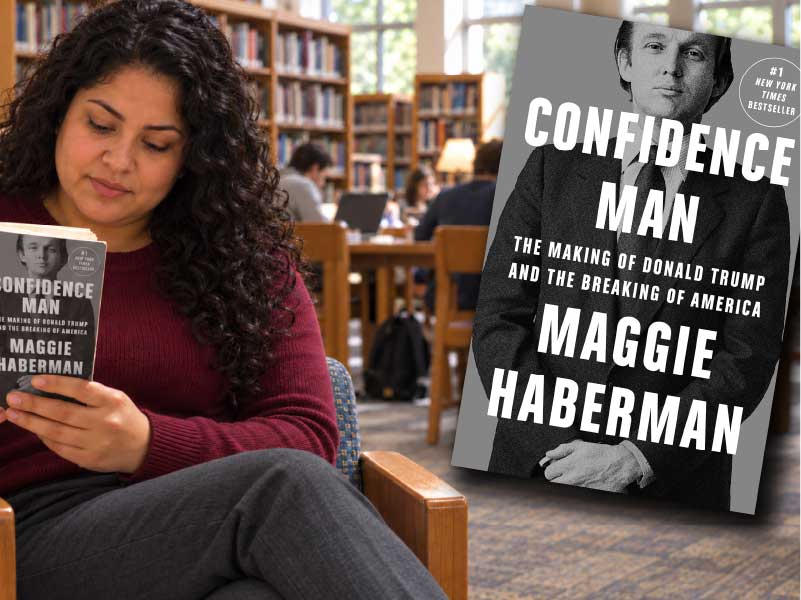
Confidence Man: The Making of Donald Trump and the Breaking of America by Maggie Haberman
“Haberman had the unenviable task of covering this empty person, a man who routinely, obviously, and often pointlessly lied to her, who abused her publicly when it served him while flattering her privately in hopes of getting her to write “nice things” about him. Confidence Man is an accomplished piece of reporting about the nothingness that is Trump. But what’s fascinating about Trump and his presidency is not him, but the people around him, from the delusional Javanka, who believed they could preserve their sleek, professional-class image while benefiting from their carnival-barker patron, to craven sycophants like Lindsey Graham and Mark Meadows, and from the so-called “Axis of Adults” who accepted cabinet appointments and staff positions with the intention of curbing and redirecting the president’s impulses toward their own pet policy goals to the tormented public servants who were convinced, not without cause, that if they left the posts in which they were routinely berated and humiliated, someone would take over who would pitch the nation into a constitutional crisis. Like Saruman and Gollum, their compromises and torments are more interesting than the dark lord they served.
And finally, there’s Trump’s base, without which none of this fiasco would have transpired. Why did they settle on a sleazy New York real estate developer as their messiah? Why did they credulously swallow his impression of an effective executive on TV even as they claim to regard all media with skepticism? At the 2016 Iowa caucuses, Haberman asked a man why he planned to vote for Trump, and the man told her, “I watched him run his business.”
Laura Miller’s review of Confidence Man, published in Slate, Oct 06, 2022.
-
Item Seven
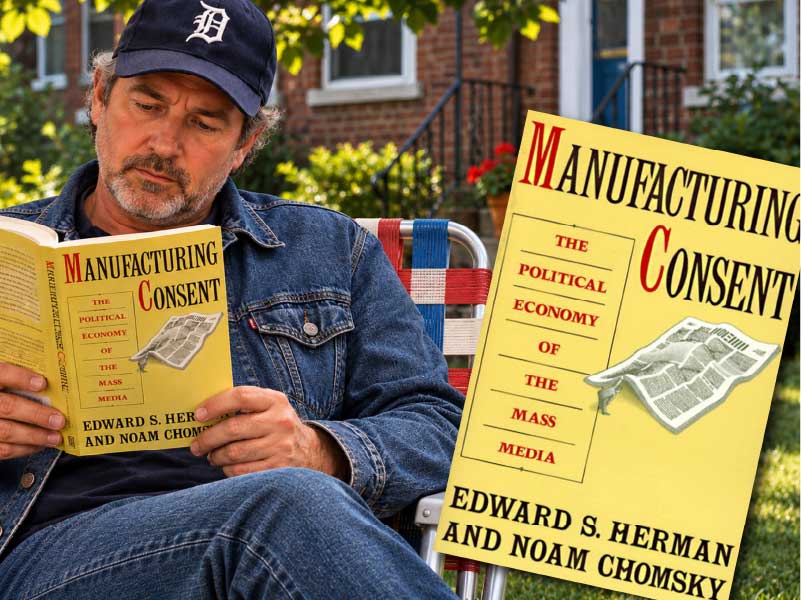
Manufacturing Consent: The Political Economy of the Mass Media by Edward S. Herman and Noam Chomsky
How can “the will of the people” be the legitimate basis for the authority of the government in modern post-industrial societies where the pervasive mass media is co-opted or controlled outright by the power of the same elites who control the government, the largest corporations and, ultimately, the mass media itself?
Since the first publication of Manufacturing Consent in 1988 what has come to be known as the “Propaganda Model” the authors described has only become more centralized and dependent on official and corporate sources for access and “expertise”
The critical analysis that Herman and Chomsky applied to mass media reflected their perspectives as famous academics who had both been radicalized by American neocolonialism and the geopolitical and ideological struggle with the USSR and other communist nations. The war in Vietnam in particular was the main subject of their first collaboration, the 1973 book Counter-Revolutionary Violence: Bloodbaths in Fact and Propaganda. But it was Manufacturing Consent that proved to be the most celebrated of the three books they coauthored. Their joint deconstruction of the propagandistic “filters” through which mass media perceive, and present, the world, looked at the linked economic and cultural forces redefining the body politic. (The following quoted sections were all written by the coauthors.)
“The steady advance, and cultural power, of marketing and advertising has caused "the displacement of a political public sphere by a depoliticized consumer culture." And it has had the effect of creating a world of virtual communities built by advertisers and based on demographics and taste differences of consumers. These consumption-and style-based clusters are at odds with physical communities that share a social life and common concerns and which participate in a democratic order. These virtual communities are organized to buy and sell goods, not to create or service a public sphere.”
The scale and concentration of mass media ownership, run by elite wealthy owners seeking profit depends on a business model in which the real product is the audience, packaged and delivered by mass media to the corporations which pay them primarily for entertainment, not uncensored public information. This “political economy” restricts featured expressed opinion ranging only within a prescribed ambit, shutting out countervailing opinions. The sources, both confidential and public who provide the vast organs of the mass media with the gist for their mills are often as not large profit-seeking entities that can afford to construct and control information.
“Only the corporate sector has the resources to produce public information and propaganda on the scale of the Pentagon and other government bodies.”
Journalists and other media professionals rely on information provided by government, business, and “experts” who are typically approved and financed by these primary sources, and whose agenda is not devised or enforced by a conspiracy or overt coercion but on a shared consensus about what constitutes acceptable public knowledge. The “expert class” even when they believe they are acting benevolently are used as a weapon by governments and corporate conglomerates to suppress genuine, participatory democracy.
“Newsworkers are predisposed to treat bureaucratic accounts as factual because news personnel participate in upholding a normative order of authorized knowers in the society.”
And when opinions do fly free of the confining gravity of the prevalent spheres of information? Then these same “experts” become gatekeepers by disciplining the errant media with ‘flak” - attacking their reputations and sources and undermining their credibility. When the errant dissenters fail to “self-censor” themselves, the flak escalates with more stringent methods, ranging from letters-to-the-editor to columns, speeches, lawsuits and even proposed legislation. Lobbyists, think tanks, government agencies and the public affairs offices of powerful corporations and institutions enforce a code of mutual consent.
The authors demonstrate the actual function of the “filters” with case studies in which the practice of newsgathering and dissemination serves an ideological purpose, the enhancement of wealth and power among and for the elite. Alongside recounting conflicts and “sponsored” elections in Indochina and Latin America (such as the contrasting portrayals of democratic elections in El Salvador versus Nicaragua), as primary examples the authors write in some detail describing the stark contrast in word counts, the frequency of reporting, featured placement and other news coverage metrics between "worthy" victims (a Polish priest allied with the Solidarity movement in Poland who was kidnapped, brutally beaten, and murdered by the secret police) and "unworthy" victims (Archbishop Óscar Romero and four missionary nuns murdered by the U.S.-backed El Salvador National Guard.) It is a data driven analysis, but it lacks nothing in moral fervour or conviction.
Noam Chomsky's Manufacturing Consent revisited | The Listening Post
-

Item Eight
The Left Hand of Darkness by Ursula K. Leguin
“Hard times are coming, when we’ll be wanting the voices of writers who can see alternatives to how we live now, can see through our fear-stricken society and its obsessive technologies to other ways of being, and even imagine real grounds for hope. We’ll need writers who can remember freedom—poets, visionaries—realists of a larger reality.” ~ Ursula Kroeber Leguin, in her 2014 National Book Awards speech upon receiving the Medal for Distinguished Contribution to American Letters.
The Left Hand of Darkness is the book that many of her most admiring readers felt Ursula K. Leguin was born to write. The daughter of two prominent anthropologists who taught at UC Berkeley, her upbringing influenced her fiction which often featured intricately detailed descriptions of alien societies using their language and symbolism as motifs to craft character development and motivate plot and narrative. But the novel is also suffused with Taoist philosophy and the awe of the natural world. Published in1969 as second wave feminism was redefining the status of women among the radical Left, it was many senses prefigurative, anticipating intersectional theory and questioning the paradigm of biologically determined gender - “social science” fiction that posited the evolution of human relations rather than the advancement of technology as the transformative key to a radically different “future.”
A lone human ambassador from the Ekumen (the interplanetary league of worlds) named Genly Ai sets off to the frigid planet called Gethen (translated as “Winter”), where he is struck by how the folklore and philosophy of its’ gender fluid inhabitants makes nearly every common relationship among them exceedingly strange or exotic to his reckoning. Political intrigues force Genly Ai to undertake a dangerous expedition into the frozen wastelands in the company a sympathetic Gethenian, Estraven. In the course of their harrowing journey, Genly Ai fixed notions of his own identity give way to a new Weltanschauung.
Although it is considered a classic, it has been banned in parts of the United States and in Russia, censored because of its’ sexual content, themes of gender fluidity, and the exploration of androgyny and non-binary identities.
"It was important to think about privilege and power and domination in terms of gender. Which was something that fantasy had not done." ~ Ursula K. Leguin
Ursula K Le Guin, by Margaret Atwood: ‘One of the literary greats of the 20th century”
A clip from the American Masters documentary Worlds of Ursula K. Le Guin
-

Item Nine
Run for Something: A Real-Talk Guide to Fixing the System Yourself by Amanda Litman, with a Foreword by Hillary Rodham Clinton
"There are half a million elected officials in the United States. Why can’t you be one of them?" - Amanda Litman
In the wake of the 2016 election, Amanda Litman, the co-founder of the progressive organization Run for Something, wrote this primer on campaigning for public office for an intended audience of progressive and Democratic-leaning everyday citizens. Litman coaches those who want to be candidates for public service, outlining the logistical essentials of launching a campaign, and tells you how to get elected with minimal resources. She intersperses her “essentials” with wisdom and insights from elected officials and political operatives that she interviewed for this book.
Amanda Litman identifies and explains a 12-Step Campaign Primer, a 4-phase blueprint for progressives running for local, down-ballot offices:
Phase 1: Self-Reflection & Finding Your Race
- Step 1: Check Your Privilege and Motives
- Step 2: Pick the Right Local Office
- Step 3: Research the Logistics and Eligibility
Phase 2: Building the Legal & Narrative Foundation
- Step 4: File the Correct Paperwork
- Step 5: Define Your Personal Narrative ("The Story of You")
- Step 6: Build Your Initial "Kitchen Cabinet"
Phase 3: Funding and Fueling the Field
- Step 7: The Uncomfortable Art of Fundraising
- Step 8: Master Local Data and the Voter File
- Step 9: Direct Field Tactics (Knocking on Doors)
Phase 4: Scaling, Organizing, and Pushing to the Finish
- Step 10: Digital Organizing & Email Strategy
- Step 11: Endorsements and Coalition Building
- Step 12: Get Out the Vote (GOTV)
-

Item Ten